elephant.kernels.AlphaKernel
-
class
elephant.kernels.AlphaKernel(sigma, invert=False)[source]¶ Class for alpha kernels.

with
 .
.Examples
from elephant import kernels
import quantities as pq
import numpy as np
import matplotlib.pyplot as plt

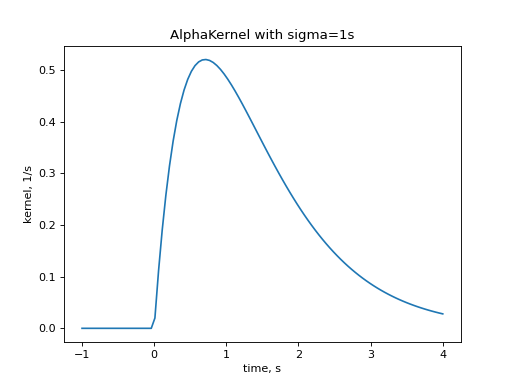
time_array = np.linspace(-1, 4, num=100) * pq.s
kernel = kernels.AlphaKernel(sigma=1*pq.s)
kernel_time = kernel(time_array)
plt.plot(time_array, kernel_time)
plt.title("AlphaKernel with sigma=1s")
plt.xlabel("time, s")
plt.ylabel("kernel, 1/s")
plt.show()
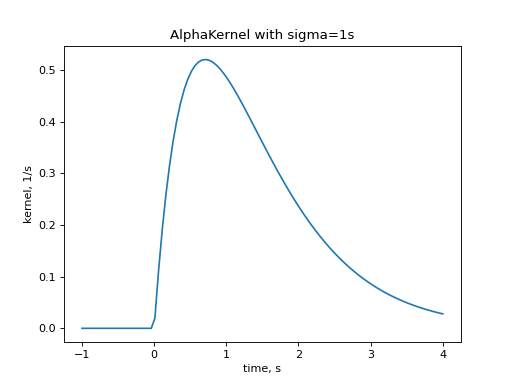
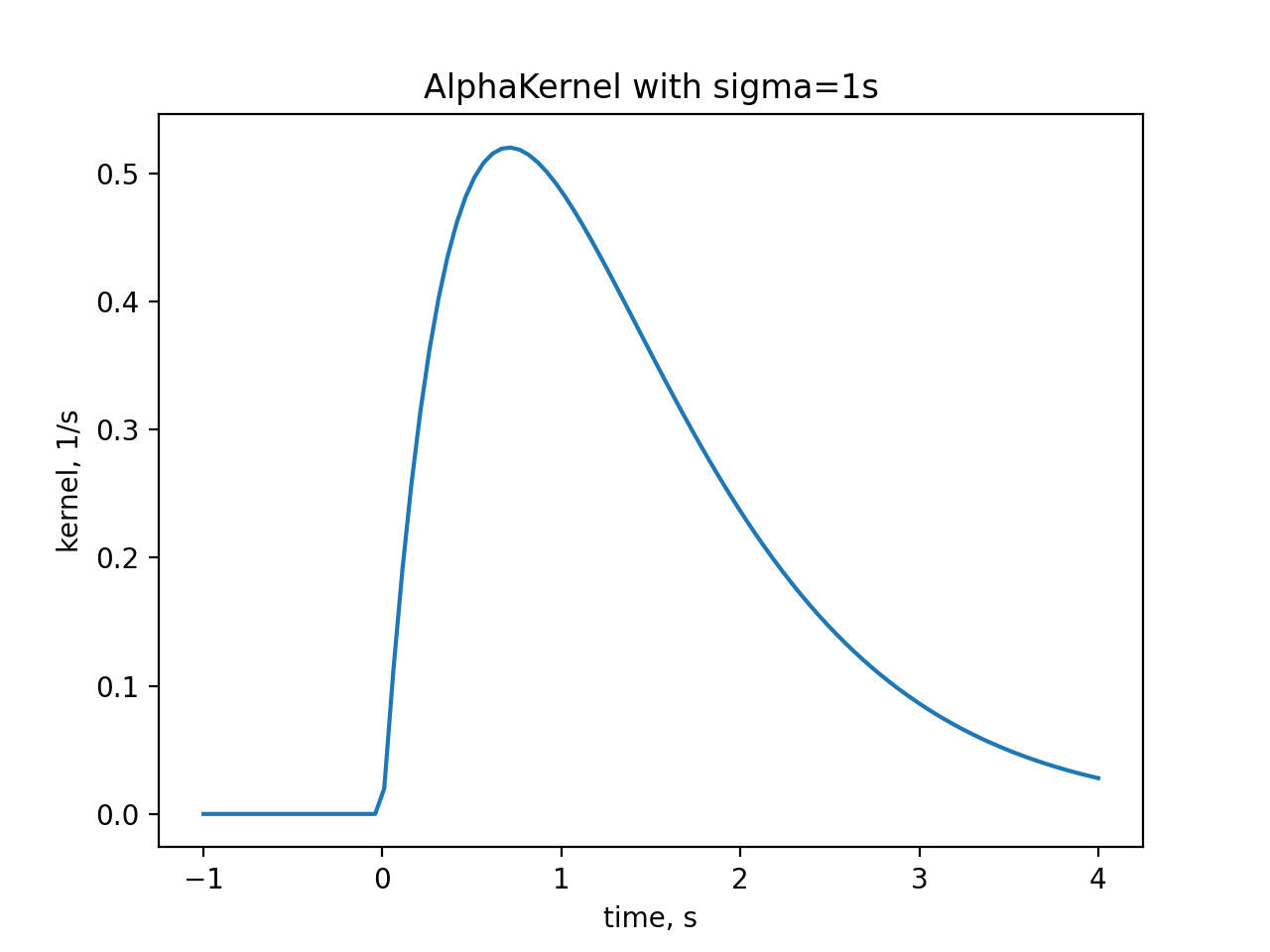
(Source code, png, hires.png, pdf)
Methods
__call__(times)Evaluates the kernel at all points in the array times. boundary_enclosing_area_fraction(fraction)Calculates the boundary  so that the integral from
  to encloses a certain fraction of the integral over the complete kernel.
cdf(time)Cumulative Distribution Function, CDF. icdf(fraction)Inverse Cumulative Distribution Function, ICDF, also known as a quantile. is_symmetric()True for symmetric kernels and False otherwise (asymmetric kernels). median_index(times)Estimates the index of the Median of the kernel. Attributes
min_cutoffHalf width of the kernel. -
boundary_enclosing_area_fraction(fraction)[source]¶ Calculates the boundary
so that the integral from
to encloses a certain fraction of the
integral over the complete kernel.By definition the returned value is hence non-negative, even if the whole probability mass of the kernel is concentrated over negative support for inverted kernels.
Parameters: - fractionfloat
Fraction of the whole area which has to be enclosed.
Returns: - pq.Quantity
Boundary of the kernel containing area fraction under the kernel density.
Raises: - ValueError
If fraction was chosen too close to one, such that in combination with integral approximation errors the calculation of a boundary was not possible.
-
cdf(time)[source]¶ Cumulative Distribution Function, CDF.
Parameters: - timepq.Quantity
The input time scalar.
Returns: - float
CDF at time.
-
icdf(fraction)[source]¶ Inverse Cumulative Distribution Function, ICDF, also known as a quantile.
Parameters: - fractionfloat
The fraction of CDF to compute the quantile from.
Returns: - pq.Quantity
The time scalar times such that CDF(t) = fraction.
-
is_symmetric()¶ True for symmetric kernels and False otherwise (asymmetric kernels).
A kernel is symmetric if its PDF is symmetric w.r.t. time:

Returns: - bool
Whether the kernels is symmetric or not.
-
median_index(times)¶ Estimates the index of the Median of the kernel.
We define the Median index
 of a kernel as:
where
 and
and  are the first and last entries of
the input array, CDF and ICDF stand for Cumulative Distribution
Function and its Inverse, respectively.
are the first and last entries of
the input array, CDF and ICDF stand for Cumulative Distribution
Function and its Inverse, respectively.This function is not mandatory for symmetrical kernels but it is required when asymmetrical kernels have to be aligned at their median.
Parameters: - timespq.Quantity
Vector with the interval on which the kernel is evaluated.
Returns: - int
Index of the estimated value of the kernel median.
Raises: - TypeError
If the input array is not a time pq.Quantity array.
- ValueError
If the input array is empty. If the input array is not sorted.
See also
Kernel.cdf- cumulative distribution function
Kernel.icdf- inverse cumulative distribution function
-
property
min_cutoff¶ Half width of the kernel.
Returns: - float
The returned value varies according to the kernel type.
-